
Showing posts with label mythology. Show all posts
Showing posts with label mythology. Show all posts
Sunday, October 25, 2015

Monday, March 10, 2014
COLOR ME HAPPY HOLI.
Holi: the festival of colorrrishous fun.
WHERE: Mostly the north half of India.
WHEN: Day after the first full moon in March (usually.)
WHY: Well, there are many reasons. The more mundane ones are that HOLI signifies the end of winter, the Spring harvest and bounty. Mythologically, HOLI can be attributed to:
1. The immolation of the demoness HOLIKA, who on behest of her demon-king brother, HIRANYAKASHIPU, tried to assassinate her nephew, PRAHALAD, a devotee of LORD VISHNU. Vishnu saves Prahalad and sets aflame HOLIKA instead. The good old Good vs. Evil myth.
2. Another one is how a bunch of kids from the village of PRTHU, supernaturally aided by LORD SHIVA, managed to run-off a big, bad ogress DHUNDHI.
3. HOLI-day is also the day when LORD SHIVA (the god of destruction) opened his THIRD EYE and set fire to LORD KAMA (the god of love) for interfering in his business.
4. MY favorite by far of these HOLI myths is about KRISHNA-RADHA.
Out of jealousy, the young Lord Krishna (an incarnation of Lord Vishnu) asked his mother YASHODA why Radha (a village belle and his first love...some say his only great love) was so pretty and fair and he so dark. Yashoda shook her head in exasperation and told him to go paint Radha's face to match his own or vice versa. Krishna, always willing to play mischief on the village belles, thoroughly enjoyed coloring Radha with red mud from the banks of the river. And so, to this day, the great love of Krishna-Radha is celebrated on HOLI with GULAL, dance and music. Not to mention, BHANG (a drink prepared from the leaves and flowers of Cannabis.)
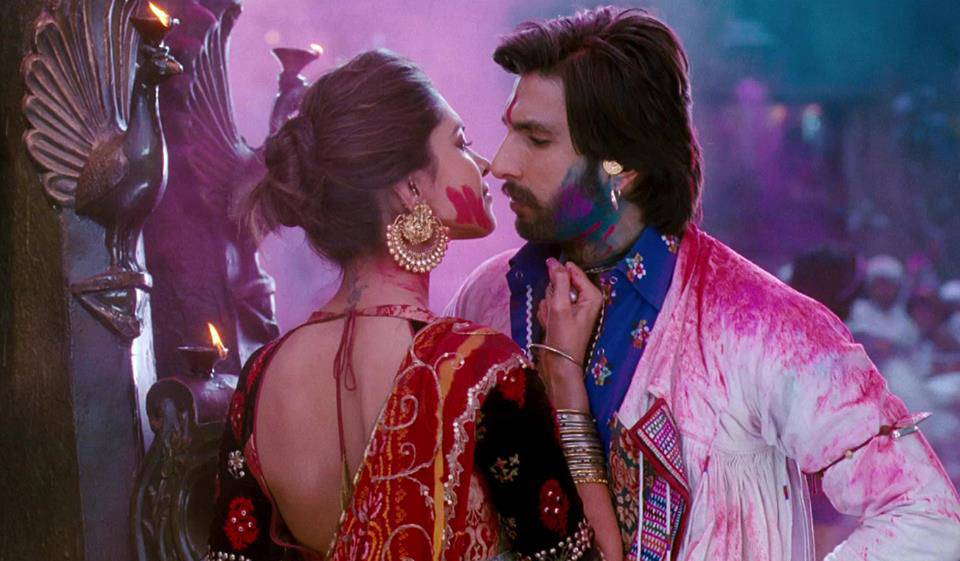
 HOW: In earlier times, Gulal was made from the flowers of a tree called the FLAME OF THE FOREST. Quite apt, as Gulal is mostly the colors of fire: red, orange, saffron, yellow etc. Though, in recent times any and all colors are thrown about. Anyway, the Gulal and AABIR (made from natural colored talc) that were used in medieval times were actually good for the complexion and not the synthetic, chemical powders of today that sometimes cause allergic reactions on skin. Then there's the PICHKARI, elaborate water pistols, to soak the color into the HOLI-players, who in their white outfits are like canvases just waiting to be color-splashed by artists.
Hordes of happy people on the streets, colors, song, dance, water-fights...Yes, it is as fun as it sounds and is about the only festival of India I truly miss in NY (Don't believe me, watch the video I've posted above.)
Friday, December 27, 2013
DIVINE CHILD MYTHS
A vast majority of the world's myths and religions prescribe to the idea of a Divine Child who might be a god, demi-god, hero or savior come to change the world (the triumph of good versus evil). The Child is most often not conceived naturally. The Divine Mother has an encounter with a ruling deity or pure spirit and gives birth (again most often not naturally) to the god-like child, often of royal lineage.
Fascinatingly, there are a horrendous amount of such births in the world's cultural collectives (a terrific number in Indian myths alone). I am going mention those I know, if you know more, then I'd love to hear about them.

1. Jesus Christ - Son of God, virgin birth to the Virgin Mary. (Christian)
2. Horus - son of the Sun God, divine child born to the virgin goddess Isis. (Ancient Egypt)
3. Krishna - Reincarnation of God Vishnu born to the royals Vasudeva and Devaki in prison. Secreted out of prison in the middle of the night and raised by cowherds Nanda and Yashoda. When he came of age, he went back to free his parents and assassinate his evil uncle, Kamsa, who had his parents imprisoned. (Hinduism)
4. Greek mythology is full of strange births from the Titan Cronus, to his son, Zeus, to Zeus' offspring Athena, Perseus, Dionysus, Heracles (Hercules), Helen of Troy etc.
5. Romulus and Remus - Vestal Virgin, Rhea Silvia gets impregnated either by the God Mars or Hercules and births the twins. Her evil brother, King Amulius, orders their drowning in the twins in the river Tiber. The twins survive somehow, and are found and adopted by a she-wolf. She nurses them as babes. A woodpecker feeds them as they grow older and they are finally adopted by a shepherd. They grow up, kill their uncle, restore Numitor, the rightful king-uncle to the throne, become heroes and found Rome.
6. The Indian Epic, the Mahabharata, has a countless number of such births. It is supposedly an accounting of the ancient kings of India.
Kunti's offspring. Kunti is a key figure in the epic, the mother of the heroes. Mother too, of one tragic hero, her first-born, Karna. She was given a boon from the Sage Durvasa, a boon to be used after marriage as it summoned Gods from the Hindu pantheon to impregnate her. She foolishly chanted the mantra as a young girl and accidentally summons the Sun God, Surya. He impregnates her and she gives birth to Karna, through her ear, as she must remain a virgin to be wed honorably. She abandons the child in the river.
The second, their and fourth times she summons Gods, its within the sanctions of her marriage and on behest of her husband, the weak and impotent, King Pandu who has abdicated the throne.
She gives birth to Yudhishtira by Yama, the God of Death. Bhima by Vayu, the God of Wind and Arjuna by Indra, the God of War and Thunder. Her husband's second wife begs for children and using the mantra gives birth to Nakul and Sahadeva, twins by the twin gods, the Ashwins.
The rival Kuru family could not remain ordinary in such circumstances. Thus Queen Gandhari after a two-year pregnancy gives birth to a lump of clay, which is then on the advice of sages and gods, separated into 101 lumps of clay and left to gestate in bowls or vases. They grow into the 100 Kaurava brothers and their only sister.
The five demi-god Pandava brothers, all marry the princess of Panchal, Draupadi, who emerged fully formed from a fire with her twin brother, Dhrishtadyumna.
Okay, I'm tired of writing as I'm sure you guys are fed up of reading what is essentially the same concept over and over. There's an interesting version of why such myths exist that has to do with our spiritual and psychological evolution or awakening or rebirth or recreation, our Kundalini energy. But I won't go into that just yet.
Monday, September 9, 2013
THE AGE OF MYTH
The Deluge:
Let me tell you a story...
 Innumerable years ago, Vaivasvata Manu while performing ablutions and religious rituals on the banks of the river Chervi accidently catches a tiny fish in his cupped hands. The fish introduces himself as Matsya, asks Manu to spare his life and protect him from the creatures of the river.
If the request was a test of character, Manu passes it with flying colors. He transfers Matsya into an earthen pot filled with water and takes him home. When Matsya grows too big for the pot, Manu digs a ditch outside his house for the fish. And still Matsya grows and Manu transfers him into a pond, then a lake, then to the mighty Ganges River (called the spouse of the Ocean.) When Matsya grows so massive that even the Ganges cannot harbor him, Manu assists Matsya in his journey to the Ocean.
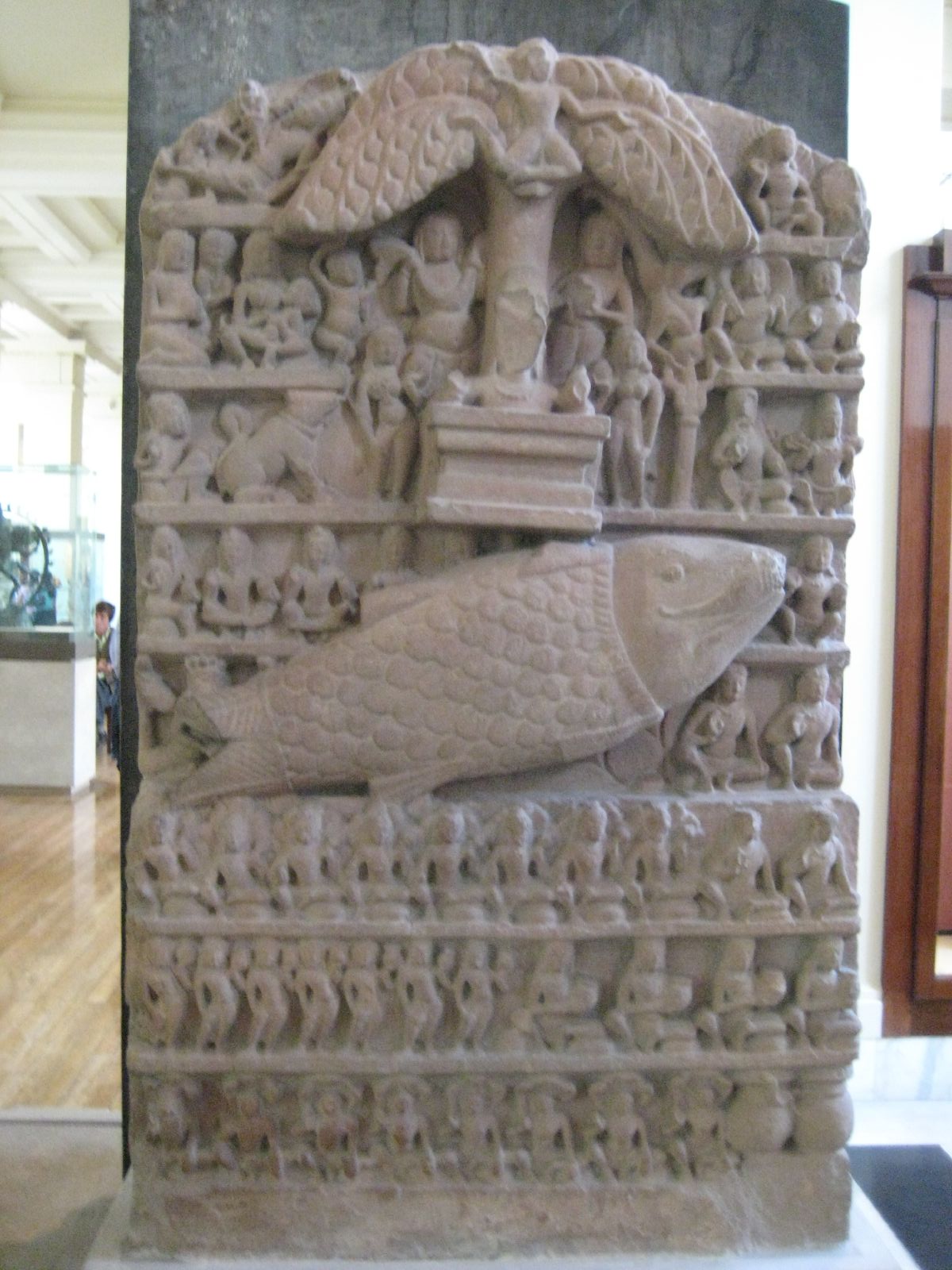 |
| Source: British Museum |
There they part company, but before they do, Matsya promises to save and protect Manu as Manu had done him. Matsya foretells of a great catastrophic flood that would submerge the whole world. The fish advises Manu to build a great big boat, gather the Saptarishis (the seven great sages) and collect all the seeds of the world and keep them close.
In due course, the flood came. Manu, the Saptarishis and the grain boarded the boat and the great horned fish, Matsya, as promised, navigated the boat to the heights of the Himalayas and tethered it to safety. Matsya then reveals himself as Prajapati Brahma, lord creator of the universe. He then passes the mantle of Prajapati (Creator) to Manu, urging him to create Man and set up the Ways of Civilization.

"Myth is essentially a cultural construct, a common understanding of the world that binds individuals and communities together. This understanding maybe religious or secular. Ideas such as rebirth, heaven and hell, angels and demons, fate and freewill, sin, Satan and salvation are religious myths. Ideas such as sovereignty, nation state, human rights, women's rights, animal rights and gay rights are secular myths. Religious or secular, all myths make profound sense to one group of people. Not to everyone. They cannot be rationalized beyond a point. In the final analysis, you either accept them or you don't." ~ Dr. Devdutt Pattanaik.
Subscribe to:
Posts (Atom)