Wednesday, September 18, 2013

SORROW

Sorrow and loss touch everyone, no exception. They come at the unlikeliest of times, robbing us of breath and speech and sometimes our soul. But it is in such moments that we know our true character and our best courage. So, be sure to welcome them when they greet you next.

This is a song of loss that I love. A song of memories, heartbreak and survival. Hope you enjoy it too. 

Tears From Heaven by Eric Clapton.


And here's a quote from the book I just finished reading that sparked this mood...


“I will find you," he whispered in my ear. "I promise. If I must endure two hundred years of purgatory, two hundred years without you - then that is my punishment, which I have earned for my crimes. For I have lied, and killed, and stolen; betrayed and broken trust. But there is the one thing that shall lie in the balance. When I shall stand before God, I shall have one thing to say, to weigh against the rest."

His voice dropped, nearly to a whisper, and his arms tightened around me.

Lord, ye gave me a rare woman, and God! I loved her well.” 

Monday, September 9, 2013

THE AGE OF MYTH

The Deluge:

Let me tell you a story...

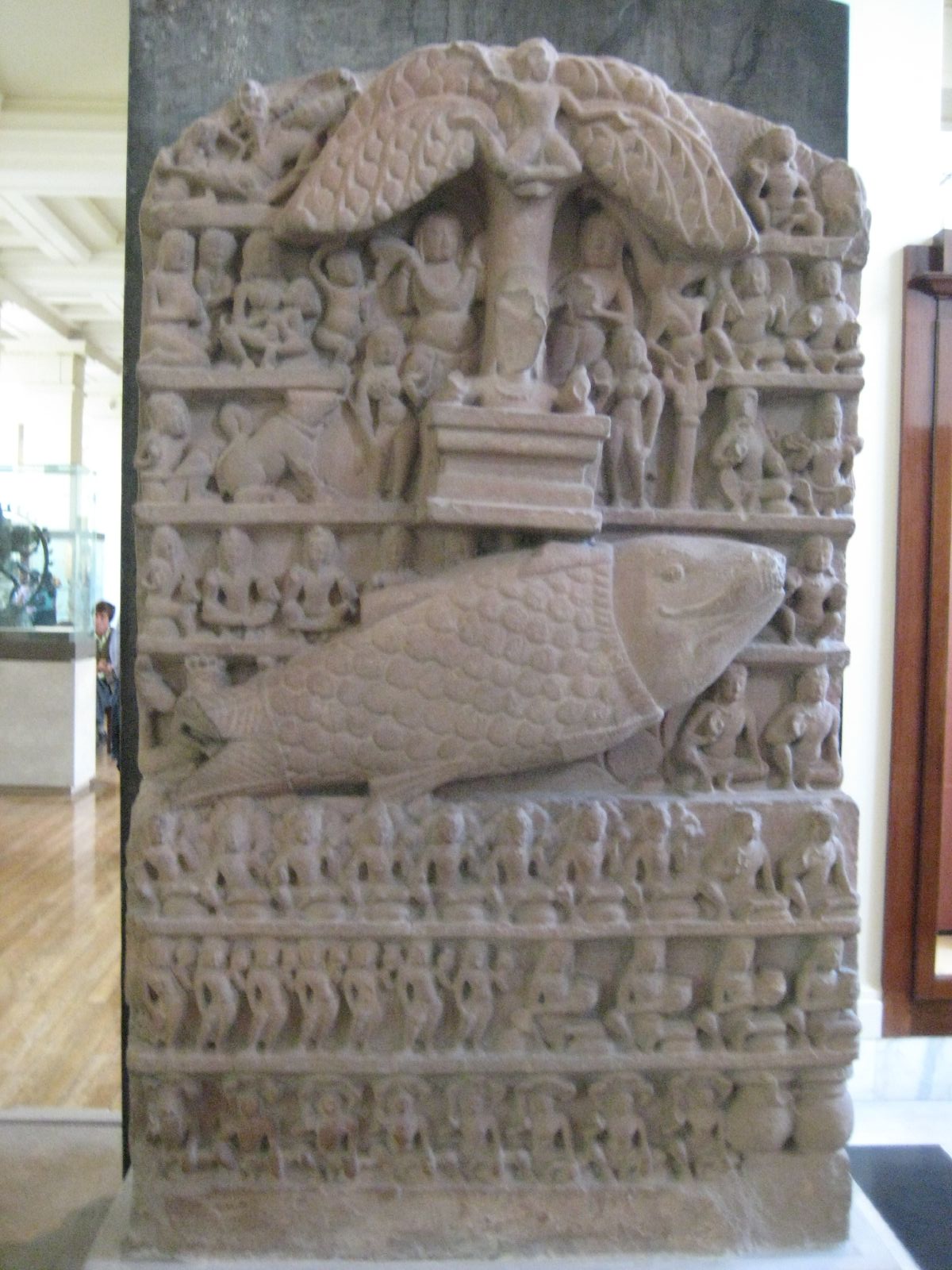
Innumerable years ago, Vaivasvata Manu while performing ablutions and religious rituals on the banks of the river Chervi accidently catches a tiny fish in his cupped hands. The fish introduces himself as Matsya, asks Manu to spare his life and protect him from the creatures of the river. 

If the request was a test of character, Manu passes it with flying colors. He transfers Matsya into an earthen pot filled with water and takes him home. When Matsya grows too big for the pot, Manu digs a ditch outside his house for the fish. And still Matsya grows and Manu transfers him into a pond, then a lake, then to the mighty Ganges River (called the spouse of the Ocean.) When Matsya grows so massive that even the Ganges cannot harbor him, Manu assists Matsya in his journey to the Ocean. 
Source: British Museum


There they part company, but before they do, Matsya promises to save and protect Manu as Manu had done him. Matsya foretells of a great catastrophic flood that would submerge the whole world. The fish advises Manu to build a great big boat, gather the Saptarishis (the seven great sages) and collect all the seeds of the world and keep them close.

In due course, the flood came. Manu, the Saptarishis and the grain boarded the boat and the great horned fish, Matsya, as promised, navigated the boat to the heights of the Himalayas and tethered it to safety. Matsya then reveals himself as Prajapati Brahma, lord creator of the universe. He then passes the mantle of Prajapati (Creator) to Manu, urging him to create Man and set up the Ways of Civilization.

Manu, Noah or Gilgamesh, what we learn from these legends is that the deeper we dig into diversity, the closer we'll come to the One Truth.


"Myth is essentially a cultural construct, a common understanding of the world that binds individuals and communities together. This understanding maybe religious or secular. Ideas such as rebirth, heaven and hell, angels and demons, fate and freewill, sin, Satan and salvation are religious myths. Ideas such as sovereignty, nation state, human rights, women's rights, animal rights and gay rights are secular myths. Religious or secular, all myths make profound sense to one group of people. Not to everyone. They cannot be rationalized beyond a point. In the final analysis, you either accept them or you don't." ~ Dr. Devdutt Pattanaik.

Sunday, September 1, 2013

LETS BLOG ABOUT SHOES, BABY 2

Hello Darlings, missed me? Aw. How sweet. I missed you too. Now, here are some more a-shoe-rances that Man cannot be Man without his Sole and that's not just mine opinion but Shakespeare's as well.


MARULLUS
Where is thy leather apron and thy rule?
What dost thou with thy best apparel on?
You, sir, what trade are you?
Second Commoner
Truly, sir, in respect of a fine workman, I am but,
as you would say, a cobbler.
MARULLUS
But what trade art thou? answer me directly.
Second Commoner
A trade, sir, that, I hope, I may use with a safe
conscience; which is, indeed, sir, a mender of bad soles.
MARULLUS
What trade, thou knave? thou naughty knave, what trade?
Second Commoner
Nay, I beseech you, sir, be not out with me: yet,
if you be out, sir, I can mend you.
MARULLUS
What meanest thou by that? mend me, thou saucy fellow!
Second Commoner
Why, sir, cobble you.
FLAVIUS
Thou art a cobbler, art thou?
Second Commoner
Truly, sir, all that I live by is with the awl: I meddle with no tradesman's matters, nor women's matters, but with awl. I am, indeed, sir, a surgeon to old shoes; when they are in great danger, I recover them. As proper men as ever trod upon neat's leather have gone upon my handiwork.

Who are we to argue with the Bard, hm?
And to continue my Shoe Story...


Footwear became increasingly important, complex and industrious after the 1600s. Women no longer wanted to wear shoes the same shape as men (thank heavens.) Heels became popular along with design and comfort. Men's shoes had always been steadfast and sober - yech, personally but to each his own. But women's shoes became elaborate extensions of their feet, their soles (pun, pun, pun!) and in Cinderella's case, the means to her soulmate.

There you have it, the Importance of a Good Pair of Shoes (that shoeld be a title of a movie, na?) A small observation? There are no saucier, finer, neater pair of shoes than Lady Gaga Heels in the world today.


Wednesday, August 28, 2013

LET'S BLOG ABOUT SHOES, BABY.

Let me introduce you to Diya Mathur. She's a tall, thin supermodel in love with life...and with the Beast since she was 11. A ditzy, darling of a diva, her one obsession besides the Beast is Shoes. She's a Sole Sista and in this blog, she's going to educate you on a thing or two about SHOES.


A brief history of the SHOE by Dee-Dumbs: note that  I'm more stimulated by visuals than prose, hence, I'll post more pics than pratter.

8000 BC: worn as a protection against the elements as Earth was pretty much a slowly thawing glacier then.


3000 BC: In ancient Egypt, braided papyrus was molded into soles from sole prints taken in the sand. Can't say they were not ingenious.


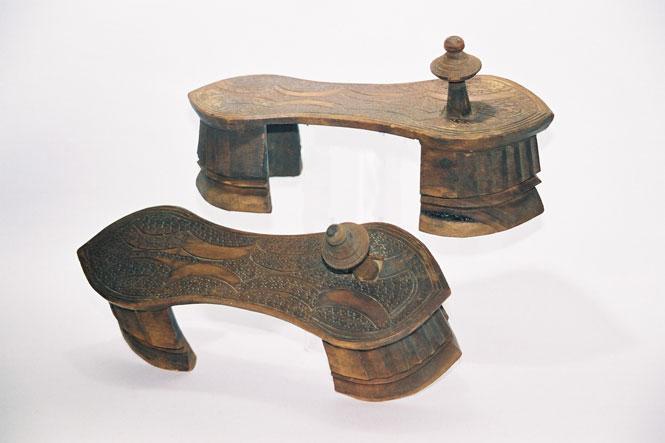
The paduka from ancient India. Hey! We had platform heels back in the Epic Age too. These are a bridal pair and I must say, the wearer had muscular toes to keep those on and not fall on her face.


Sandals (and a war boot?) used by Egyptians and Romans and Greeks.

The next big innovation in shoes came around the 4th Century AD.  Shoes are sewn inside out and then turned for use, so that the stitching is now hidden. Shoe-making materials also improved, not only leather and tree bark, now silk and brocade and velvet was stamped in. 


Then there were shoes to be worn over shoes, strangely, called pattens. And the Duck Bills for men that would reveal their colored hose through the leather.


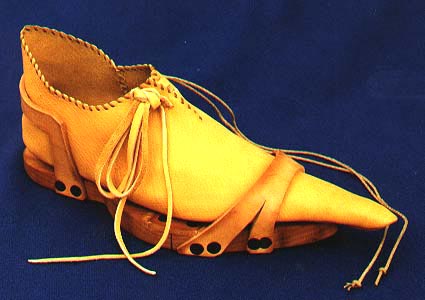
Influenced by the Middle Eastern culture, the poulaines were popular during the Crusades. 


Another ancestor of the platform, the chopine shoe was meant to be worn over your slippers to give the person height and of course, glamour. We're in 1500 AD here.


Boots became fashionable in England in the 1600s when a shoemaker designed a boot for the reigning monarch to hide his "rickety" legs.


And then the shoe industry got better and better and better... 


I've brought you up to the 20th Century. More interesting shoe-bits to follow...

Friday, August 16, 2013

CHENNAI EXPRESS

I was going to say Chennai Express is the movie of the month but no, its the movie of the year for me. All right, yes, it does star my absolute favorite, star-craze-crush, the Badshah of Bollywood, the King of Romance, and with this movie the indisputable, inimitable Pasha of Laughs - Shah Rukh Khan.
(Gasp. Swoon. Faint)


The movie borders on being a slapstick comedy but a brilliant, smart one. Its hilarious...and I mean falling on the floor, laugh out loud kind of funny. I was literally roaring with laughter. My stomach hurt, my eyes streamed and my cheeks...wow my cheeks still ache from all the laughing. The dialogues are (at the risk of repeating myself) hilarious. The only hitch? You have to be an SRK fan (Gasp. Swoon. Faint) a Bollywood flick enthusiast and a Hinglish speaker to really get the jokes.

There is the usual Bollywood masala: vibrant vistas, jiggly jingles and dis-believable dishum-dishum between the dastardly villain and the hero. Really, without said masala no one could tell the difference between a Bollywood and Hollywood flick. (cough) No really, Indian flicks can rise to the occasion every once in a while like, A Wednesday or Black.

But where's the fun in that? I, for one, see a Bollywood movie for its Item Numbers and plots that beg suspension of reality. I see them for the color, the romance, the melodrama. I especially take a trip to the big screen to watch a movie starring the super-bad SRK (Gasp. Swoon. Faint) And since Chennai Express had all of that and more in it ( Deepika Padukone wasn't bad at all) watching it on the Big Screen was a no-brainer. 

Go see it, folks, and thank me later for encouraging you to stop and tickle your funny bone.


Wednesday, August 7, 2013

THE ANSWER IS...LOVE!

I write romance novels. Correction, I LOVE writing romance novels. As my new heroine claims, love definitely makes the world go round (or it should.) 

So what is love? 

Is it a song? Is it a feeling? An action of giving and receiving? Is it a belief, in yourself and in someone else? Is it a natural state that every human should be in but very few are? Is it an act of will, sheer bloody-mindedness to see the world through red-tinted shades? Is it a self-delusion of an optimist? Is it The Path to Heaven (whichever type you believe in?)

Or is it just evolution? Nature's way of ensuring the survival of a species by triggering happy chemical responses all around our nervous system, making us do mad things like mating and marriage?

I say its all of that and more.
I say its just three little words. 

I love you. 


I love you in different languages:

Aamee tuma ke bhalo aashi - Bangla
Ngo oiy ney a - Cantonese
Ik hou van jou - Dutch
Doset daram - Persian
Je t`aime/ Je t`adore - French
Ich liebe dich - German
S`agapau - Greek
Hoo thunay prem karoo choo - Gujarati
Aloha wau ia oi - Hawaiian
Hum tumhe pyar karte hae - Hindi
Ti amo - Italian
Te amo - Latin
Ya liubliu tebya - Russian
Te quiero / Te amo - Spanish


(Images- Copyright (c) <a href='http://www.123rf.com'>123RF Stock Photos</a> and Copyright (c) <a href='http://www.123rf.com'>123RF Stock Photos</a>)

Monday, August 5, 2013

HOT AS HADES

Did you know that...

The hotness of a pepper is measured in Scoville Heat Units (SHU) that tell us the amount of capsaicin or heat producing substance found in it.


Capsaicin can and is used as a weapon against humans. 


Capsaicin is also used in topical medications.


You can make organic pepper bug spray with cayenne and habanero peppers.


You should drink milk after having pepper and not water as water just spreads the heat in your mouth/gullet/stomach while milk will cool it down.


The hottest pepper in the world is...

Bhut Jolokia Pepper (1,041,427 SHU)
also called Naga Jolokia, Ghost Pepper, and the California Death Pepper. 


Fact: I have tried it and it rocks! 
And so I dare you to try it.