Friday, October 25, 2013

24

Yesterday afternoon, while browsing E! Entertainment...er...I mean, while I was researching stuff  for my book online, I came across this...


Which is exciting. Yay. I was addicted to the series back when it was fun. (Jack Bauer, you're what they put in Red Bull's formula.)
 

And then not so much when it stopped being fun. Anyway, the point is that I got thinking...


What does my day look like?

I wondered and this is what I mapped, people. 


11:00 am to Noon: I was on the phone.

Noon to 1:00 pm: I lunched, while I was on the phone, (What the...?) and fed Truffles somewhere between my own bites. Aaand found time to play with him too. (I'm a good Mommy.)

1:00 to 2:00 pm: I worked on my manuscript. (Yeah...still writing...still living in a world of my own making. TYVM.)


2:00 to 3:00 pm: I worked on my manuscript...some more.

3:00 to 4:00 pm: I worked on my manuscript...even more. Picked up DD from school. Made myself a mug of masala chai. Drank it. 

4:00 to 5:00 pm: Worked on MS. Chatted with DD about life and school. (She's bored. But will suffer through it only because she must.) Took Truffles for his bi-annual Bordatella. Whew. I believe I was exhausted at that point. Or not...

5:00 to 6:00 pm: Drove to the dance studio and for the next hour danced the merengue, the salsa, the merengue and the salsa.

That was fun...and invigorating...and no, I don't dance alllll that well but I probably look decent enough as a red salsa-ing silhouette. 

6:00 to 7:00 pm: Dined on Thepla, Chunda, Batata nu shaak and fried cauliflower as I was starving after alllll the twirling. Then worked on the MS. (What can I say? I'm a writer.)

7:00 to 8:00 pm: DH came home. We chatted. He ate. I...yes, I know I sound like a broken record but...I worked on the MS. 

8:00 to 9:00 pm: To spice things up, I unsheathed a long, sharp scimitar and with a graceful X move slashed opponent to shreds. 

Wait! What? That's not me me who did that, it was one of my characters. ;)

9:00 to 10:00 pm: After allll that excitement, I was exhausted, natch, so I vegged in bed and watched Criminal Minds (for inspiration)...and internet stalked...people. (Did you know that Brangelina is the most, cutest, adorable-est PDA celebrity couple on Earth?)

10:00 to 11:00 pm: More of the same.

11:00 to Midnight: More. Of. The. Same. And then I fell asleep. 

Midnight to 7:00 am: Wow. Thank heavens, I don't need to monitor sleep. Sadly, I do not believe I dreamt last night.

7:00 to 8:00 am: Woke to the sound of Tweets and Email. Brushed. Breakfasted. Bid adieu to DH and DD; one was off to office, the other to school.

8:00 to 9:00 am: FaceTimed with BFF who lives in Singapore. Truffles FaceTimed too. It was cho chweet.

9:00 to 10:00 am: Googled, oogled, twitterpated about Jamie-Sam and his new promo pic. Yup, I'm still fangirling the Great JAMMF. 

So, kilts are hot again: Sam Heughan in 'Outlander'

(You'll have to click that to see some kilted scrumptiousness)

10:00 to 11:00 am: Seriously, I have no life. Working on the MS.

Not as insane as Bauer's but that's 24 hours of my life. 
Ta ta daaaah!


(source for all pics and gifs is the www.)

Thursday, October 3, 2013

TO TECH OR NOT TO TECH.

We have always been taught to move forward, upward, better ourselves, our minds and our lives. So why, when we are doing all of that in this fabulous Age of Technology do some people diss it?


ad·vance·ment

 noun \əd-ˈvan(t)-smənt\

Oft-heard rants:
~ I feel sorry for the children who don't get to be "outside" like we did.
~ I feel sorry for the people constantly stuck emailing, messaging, myopically viewing their world through their phones instead of enjoying the great wide outdoors.
~ Tcha tcha tcha! How QUALITY OF LIFE has deteriorated? Conversation through a gadget as opposed to face to face? TCHA!

Okay, here's my answer to all of the above:

Get with the program, Jurassic Park Advocates! 


Yes, its a different world. A brave new tech-heavy world. Yes, our ways of communication and interaction have changed but, good grief, so did the ways of our grandparents differ from the ways of their grandparents...and so on and so forth all the way back to the Cave Man. 
If you think that we are "wasting" time communicating via technology and not stopping to "smell" the roses that bloom in our gardens just like our ancestors did then think again. Our ancestors did not have time to smell any roses in any gardens, genetically modified, meticulously manicured or not. They worked bloody hard (unless they were toddlers or wastrels) from dawn to dusk in filth and tremendously trying circumstances to accomplish maybe 10% of the things we manage to cram into a day. True they did that roaming the great big "outdoors" but believe me, if given a choice, they'd want what we have and order in their dinner and cash their checks without leaving their couch-potato seats at all.

About this weird lament of communicating face-to-face...WTH? I'd think the point was communication, period. Who cares if its via gadgets, word of mouth or telepathy? If you are articulate and considerate and "communicative" you will get your point across regardless of its means of delivery. On the flip side, an ass is an ass is an ass be it on FaceTime or face to face. 

And I won't even bring up medical advancements. 


Advancement has always been Man's greatest ambition. From the time Man learned to walk upright he's taught himself to hunt, gather, farm, build, dream, and create. Man has leapt from darkness to fire, from walking to the wheel, from dwelling in caves to the Freedom Tower, from hieroglyphs to ebooks
We cannot stop advancement. All we can do is embrace it. Learn how to use it ethically, wield it morally and we will be fine. And have you ever stopped to consider that what we call advancement and technology today might quite possibly be obsolete tomorrow? 
Really people, stop and smell the iPhones our generation has managed to grow. Don't compare our "roses" to what was because we are past that and that time is gone for good. Look to the future in a positive way. 
To all those who still want to diss technology...Go on! Disconnect yourselves from this world, if you dare. Please. Stop working, banking, phoning, texting, bantering or bettering yourselves. Go live in a cave, look into the fire you've built with toil and sweat and meditate on it. Go fight off a bear, catch a fish and eat it raw. I don't know how you'll smell "roses" in all that, but apparently, you think you will. So, yeah, go do that and leave us Tech-runts to our HVAC's and solar illuminations and our kind of peace.

Wednesday, September 25, 2013

BIRTH: THE AGE OF MYTH

Birth of a Hero

Carrying that theme "the more things seem different, the more they are the same" I bring you three different myths of heroes from three different ancient civilizations from three vastly different ages but with bafflingly similar birth stories. These three stories propagate the thesis that all things come from THE ONE, in my humble understanding of such things. Even though each legend is unique, fitting comfortably into its own sphere of culture and mythical grouping, certain details are strong and remain constant in all three civilizations. I wonder what was so important about these unanimous details that would not let the three cultures separated by time, geography and philosophy tamper with them, even while  utterly changing the trappings surrounding the details.


The Common Theme: The newborn hero is the young sun rising from the waters, first confronted by lowering clouds, but finally triumphing over all obstacles.


SARGON

Probably the oldest transmitted hero myth in our possession is derived from the period of the foundation of Babylonia (about 2800 B.C.) and concerns the birth history of its founder, Sargon the First.

Sargon, the mighty king, King of Agade, am I. My mother was a vestal, my father I knew not, while my father's brother dwelt in the mountains. In my city Azuripani, which is situated on the bank of the Euphrates, my mother, the vestal, bore me. In a hidden place she brought me forth. She laid me in a vessel made of reeds, closed my door with pitch, and dropped me down into the river, which did not drown me. The river carried me to Akki, the water carrier. Akki the water carrier lifted me up in the kindness of his heart, Akki the water carrier raised me as his own son, Akki the water carrier made of me his gardener. In my work as a gardener I was beloved by Ishtar, I became the king, and for forty-five years I held kingly sway.

MOSES

The biblical birth history of Moses, which is told in the second chapter of Exodus, presents the greatest similarity to the Sargon legend, even an almost literal correspondence of individual traits. Already the first chapter (22) relates that Pharaoh commanded his people to throw into the river all sons that were born to Hebrews, while the daughters were permitted to live; the reason for this order is given as fear of the over-fertility of the Israelites. 

The second chapter:


And there went a man of the house of Levi, and took to wife a daughter of Levi. And the woman conceived, and bare a son: and when she saw him that he was a goodly child, she hid him three months. And when she could not longer hide him, she took for him an ark of bulrushes, and daubed it with slime and with pitch, and put the child therein; and she laid it in the flags by the river's brink. And his sister stood afar off, to wit what would be done to him. And the daughter of Pharaoh came down to wash herself at the river; and her maidens walked along by the river's side; and when she saw the ark among the flags, she sent her maid to fetch it. And when she had opened it, she saw the child and, behold, the babe wept. And she had compassion on him and said, this is one of the Hebrews' children. Then said his sister to Pharaoh's daughter, Shall I go and call to thee a nurse of the Hebrew women, that she may nurse the child for thee? And Pharaoh's daughter said to her, Go. And the maid went and called the child's mother. And Pharaoh's daughter said unto her, Take this child away, and nurse it for me, and I will give thee thy wages. And the woman took the child, and nursed it. And the child grew, and she brought him unto Pharaoh's daughter, and he became her son. And she called his name Moses: and she said, Because I drew him out of the water.

KARNA

A close relationship with the Sargon legend is also shown in certain features of the ancient Hindu epic Mahabharata, in its account of the birth of the legendary hero Karna.

The princess Pritha, also known as Kunti, bore as a virgin the boy Karna, whose father was the sun-god Surya. The young Karna was born with golden ear ornaments of his father and with an unbreakable coat of mail. The mother in her distress concealed and abandoned the boy. 
"Then my nurse and I made a large basket of rushes, placed a lid thereon, and lined it with wax; into this basket I laid the boy and carried him down to the river."
Floating on the waves, the basket reaches the river Ganges and travels as far as the city of Campa. 
"There was passing along the bank of the river, the charioteer, the noble friend of Dhritarashtra, and with him was Radha, his beautiful and pious spouse. She was wrapt in deep sorrow, because no son had been given to her. On the river she saw the basket, which the waves carried close to her on the shore; she showed it to Adhirath, who went and drew it forth from the waves." 
The two take care of the boy and raise him as their own child.

What interests me is that Karna and Sargon were born as princes/demigods and raised as commoners then had to fight their way up to king-hood again, whereas Moses experiences the opposite phenomenon. Would that be a cultural more? And if so, for what? 

(source material and some paraphrasing from Sacred Texts.)

Wednesday, September 18, 2013

SORROW

Sorrow and loss touch everyone, no exception. They come at the unlikeliest of times, robbing us of breath and speech and sometimes our soul. But it is in such moments that we know our true character and our best courage. So, be sure to welcome them when they greet you next.

This is a song of loss that I love. A song of memories, heartbreak and survival. Hope you enjoy it too. 

Tears From Heaven by Eric Clapton.


And here's a quote from the book I just finished reading that sparked this mood...


“I will find you," he whispered in my ear. "I promise. If I must endure two hundred years of purgatory, two hundred years without you - then that is my punishment, which I have earned for my crimes. For I have lied, and killed, and stolen; betrayed and broken trust. But there is the one thing that shall lie in the balance. When I shall stand before God, I shall have one thing to say, to weigh against the rest."

His voice dropped, nearly to a whisper, and his arms tightened around me.

Lord, ye gave me a rare woman, and God! I loved her well.” 

Monday, September 9, 2013

THE AGE OF MYTH

The Deluge:

Let me tell you a story...

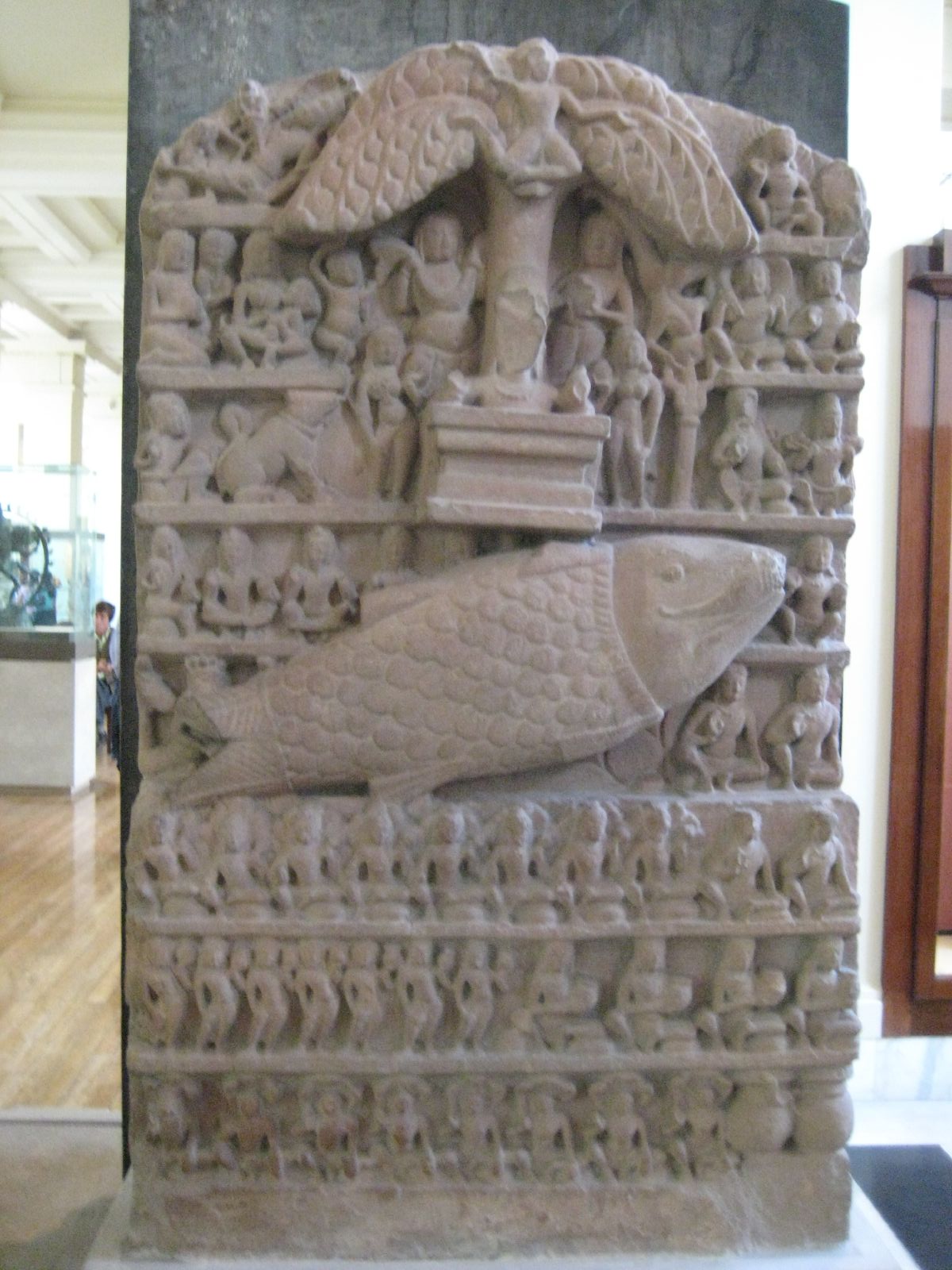
Innumerable years ago, Vaivasvata Manu while performing ablutions and religious rituals on the banks of the river Chervi accidently catches a tiny fish in his cupped hands. The fish introduces himself as Matsya, asks Manu to spare his life and protect him from the creatures of the river. 

If the request was a test of character, Manu passes it with flying colors. He transfers Matsya into an earthen pot filled with water and takes him home. When Matsya grows too big for the pot, Manu digs a ditch outside his house for the fish. And still Matsya grows and Manu transfers him into a pond, then a lake, then to the mighty Ganges River (called the spouse of the Ocean.) When Matsya grows so massive that even the Ganges cannot harbor him, Manu assists Matsya in his journey to the Ocean. 
Source: British Museum


There they part company, but before they do, Matsya promises to save and protect Manu as Manu had done him. Matsya foretells of a great catastrophic flood that would submerge the whole world. The fish advises Manu to build a great big boat, gather the Saptarishis (the seven great sages) and collect all the seeds of the world and keep them close.

In due course, the flood came. Manu, the Saptarishis and the grain boarded the boat and the great horned fish, Matsya, as promised, navigated the boat to the heights of the Himalayas and tethered it to safety. Matsya then reveals himself as Prajapati Brahma, lord creator of the universe. He then passes the mantle of Prajapati (Creator) to Manu, urging him to create Man and set up the Ways of Civilization.

Manu, Noah or Gilgamesh, what we learn from these legends is that the deeper we dig into diversity, the closer we'll come to the One Truth.


"Myth is essentially a cultural construct, a common understanding of the world that binds individuals and communities together. This understanding maybe religious or secular. Ideas such as rebirth, heaven and hell, angels and demons, fate and freewill, sin, Satan and salvation are religious myths. Ideas such as sovereignty, nation state, human rights, women's rights, animal rights and gay rights are secular myths. Religious or secular, all myths make profound sense to one group of people. Not to everyone. They cannot be rationalized beyond a point. In the final analysis, you either accept them or you don't." ~ Dr. Devdutt Pattanaik.

Sunday, September 1, 2013

LETS BLOG ABOUT SHOES, BABY 2

Hello Darlings, missed me? Aw. How sweet. I missed you too. Now, here are some more a-shoe-rances that Man cannot be Man without his Sole and that's not just mine opinion but Shakespeare's as well.


MARULLUS
Where is thy leather apron and thy rule?
What dost thou with thy best apparel on?
You, sir, what trade are you?
Second Commoner
Truly, sir, in respect of a fine workman, I am but,
as you would say, a cobbler.
MARULLUS
But what trade art thou? answer me directly.
Second Commoner
A trade, sir, that, I hope, I may use with a safe
conscience; which is, indeed, sir, a mender of bad soles.
MARULLUS
What trade, thou knave? thou naughty knave, what trade?
Second Commoner
Nay, I beseech you, sir, be not out with me: yet,
if you be out, sir, I can mend you.
MARULLUS
What meanest thou by that? mend me, thou saucy fellow!
Second Commoner
Why, sir, cobble you.
FLAVIUS
Thou art a cobbler, art thou?
Second Commoner
Truly, sir, all that I live by is with the awl: I meddle with no tradesman's matters, nor women's matters, but with awl. I am, indeed, sir, a surgeon to old shoes; when they are in great danger, I recover them. As proper men as ever trod upon neat's leather have gone upon my handiwork.

Who are we to argue with the Bard, hm?
And to continue my Shoe Story...


Footwear became increasingly important, complex and industrious after the 1600s. Women no longer wanted to wear shoes the same shape as men (thank heavens.) Heels became popular along with design and comfort. Men's shoes had always been steadfast and sober - yech, personally but to each his own. But women's shoes became elaborate extensions of their feet, their soles (pun, pun, pun!) and in Cinderella's case, the means to her soulmate.

There you have it, the Importance of a Good Pair of Shoes (that shoeld be a title of a movie, na?) A small observation? There are no saucier, finer, neater pair of shoes than Lady Gaga Heels in the world today.